Practical Statistics for Data Scientists
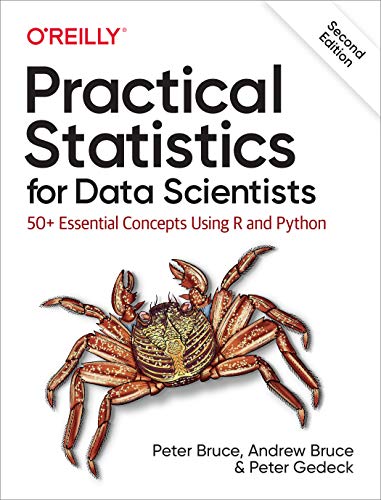
“Practical Statistics for Data Scientists” is the perfect antidote for anyone who has ever felt overwhelmed by the academic and theoretical nature of traditional statistics courses. As the title suggests, this book is highly focused on practicality, filtering out the statistical methods that are rarely used in modern data science and shining a spotlight on the concepts that actually matter in day-to-day work.
One of the most valuable aspects of this book is how it reframes traditional statistical concepts through a data science lens. It clearly explains the difference between classical statistical inference (which often focuses on small sample sizes and rigid assumptions) and modern data analysis (which leverages large datasets and computational power). The authors emphasize resampling, cross-validation, and empirical techniques over theoretical formulas, which is exactly how statistics is applied in the modern tech industry.
The book covers a wide range of essential topics, starting with Exploratory Data Analysis (EDA) and data distributions. It then moves into crucial areas like sampling, statistical experiments, and significance testing (including A/B testing, which is incredibly valuable for product data scientists). Finally, it bridges the gap into machine learning by covering regression, classification, and statistical machine learning methods. A huge plus of the recent editions is that code examples are provided in both Python and R, making it accessible regardless of your preferred stack.
What makes this book a permanent fixture on my desk is its accessibility as a reference guide. You don’t need to read it cover-to-cover to get value from it. If you need a quick refresher on the assumptions of linear regression, how to interpret a p-value correctly without falling into common traps, or how to design a proper A/B test, you can flip to the relevant chapter and find a clear, jargon-free explanation.
In short, this is an indispensable resource. It successfully distills a massive, intimidating field into a highly readable, highly actionable handbook. If you want to ensure your data science models are built on solid statistical foundations and avoid common pitfalls of data analysis, this book is an absolute must-read.