Mathematics for Machine Learning
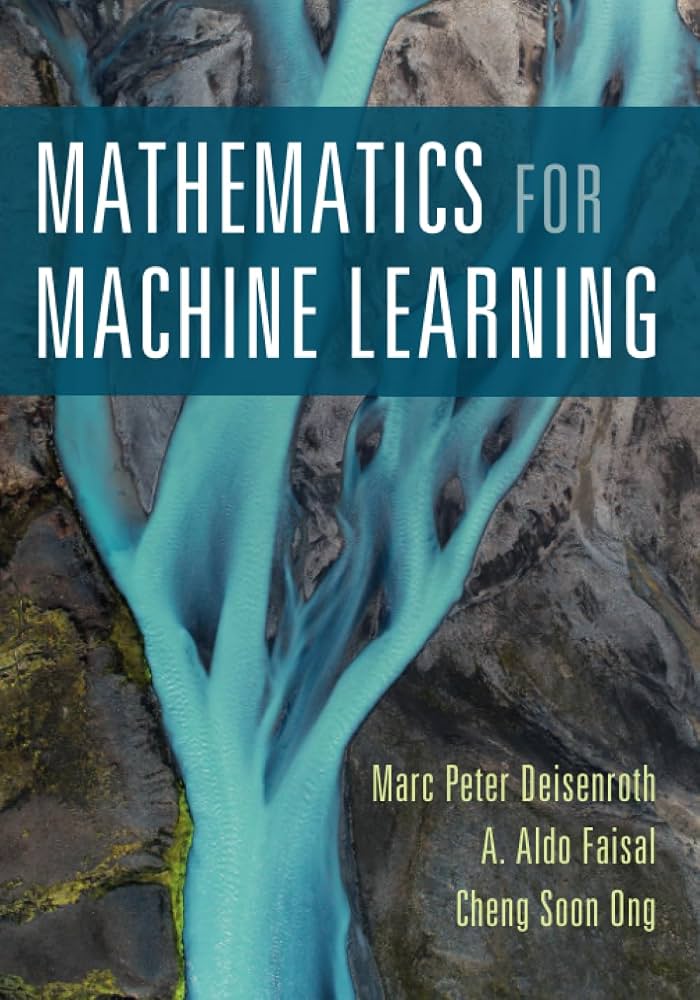
“Mathematics for Machine Learning” bridges the critical gap between theoretical mathematics and the practical applications of machine learning algorithms. For anyone looking to seriously understand how models work under the hood, rather than just blindly importing libraries, this book is an absolute necessity. It distills the vast fields of linear algebra, calculus, and probability into the specific concepts required for data science.
The first half of the book focuses exclusively on mathematical foundations. It covers linear algebra, analytic geometry, matrix decompositions, vector calculus, and probability and distributions. The authors do an excellent job of keeping the explanations concise while maintaining rigor. The focus is always on the concepts that will be directly applicable to machine learning, which saves the reader from getting lost in purely academic proofs that don’t translate to coding algorithms.
In the second half, the book transitions into applying these mathematical concepts to core machine learning algorithms. It elegantly demonstrates how linear regression, principal component analysis (PCA), Gaussian mixture models, and support vector machines (SVMs) are simply the mathematical concepts from part one put into action. Seeing the direct connection between a matrix decomposition and PCA, or vector calculus and gradient descent, provides numerous “aha!” moments.
One of the strongest points of this text is its visual approach to complex formulas. The graphs and geometric interpretations of matrices and gradients make abstract mathematical concepts tangible. However, it is not for the faint of heart; it requires a solid willingness to read mathematical notation. While it claims to be a starting point, having a basic exposure to high-school level math is highly recommended before diving in.
Overall, this is a phenomenal reference book. Whether you are an AI engineer trying to optimize a neural network, or a data scientist looking to understand the assumptions behind a statistical model, this book provides the foundational knowledge required to excel. It is a brilliant, dense, and highly rewarding read that I will be keeping on my desk for years to come.