Data Structures and Algorithms in Python
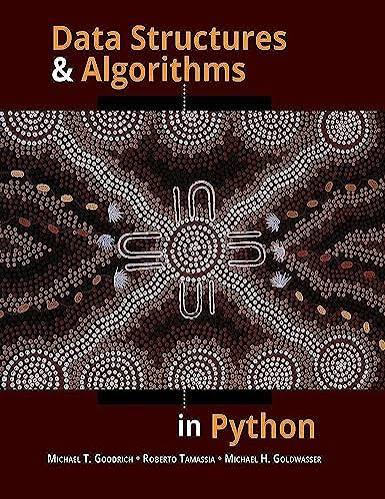
Widely regarded in the computer science community as “The Bible” of Python data structures, this textbook by Goodrich, Tamassia, and Goldwasser is a monumental achievement in technical writing. Unlike shorter, more informal tutorials, this book is a deeply academic, rigorous, and exhaustive exploration of how data structures and algorithms function at their very core.
The most defining characteristic of this book is its steadfast commitment to Object-Oriented Programming (OOP) principles. Instead of simply teaching you how to use Python’s built-in lists or dictionaries, the authors guide you through building these foundational structures completely from scratch. You will learn to design robust classes, utilize inheritance, and implement proper error handling, bridging the gap between simply writing scripts and engineering enterprise-grade software.
The breadth of content is staggering. It begins with a thorough primer on Python and OOP, moving systematically through algorithm analysis and Big-O notation. From there, it dives into arrays, linked lists, recursion, stacks, and queues, before advancing to highly complex topics like trees, priority queues, maps, hash tables, search trees, and graph algorithms. Every single data structure is accompanied by rigorous mathematical analysis regarding its time and space complexity.
Because of its academic nature, the book is incredibly dense. It is not necessarily meant for absolute beginners looking for a quick weekend read—it demands time, focus, and practice. However, what it might lack in breezy readability, it more than makes up for as an unparalleled reference guide. When you need to know exactly why a specific implementation of a Red-Black tree or a Dijkstra algorithm behaves the way it does, this is the book you turn to.
Ultimately, “Data Structures and Algorithms in Python” is an essential masterpiece for serious computer science students, professional software engineers, and anyone preparing for rigorous technical interviews at top-tier tech companies. It is a timeless reference that provides a profound, fundamental understanding of computational theory translated into Python.